Fleet van overheating in Alamo Ranch results from worn viscous fan clutches slipping 45–60% and degraded electric condenser fan motors drawing excessive current. Frequent multi-drop routes under high heat spike refrigerant pressures past safe limits. Tracking electrical loads and static pressure thresholds prevents sudden climate failures and protects delivery uptime.
Viscous Fan Clutch Degradation and Fleet Asset Downtime
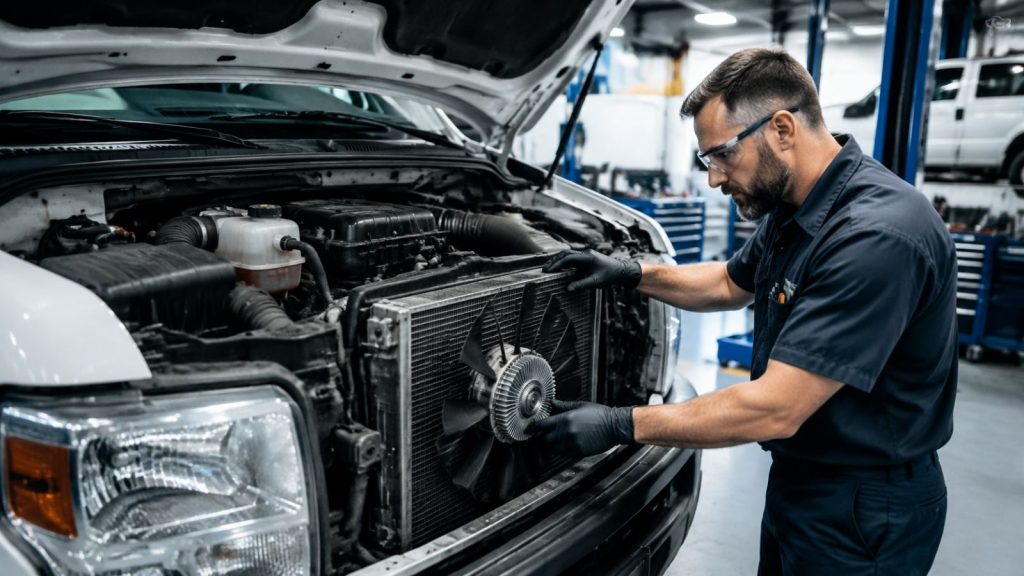
Commercial delivery vehicles operating across local distribution routes undergo severe thermal cycling. This cycling silently degrades mechanical fan clutch assemblies over time.
A professional viscous fan clutch utilizes an internal silicone fluid reservoir and a front-mounted bimetallic coil. Together, these parts control fan blade engagement based on engine operating temperatures.
In a healthy baseline state, a locked clutch exhibits a minimal slippage range of just +12% to +18% relative to the water pump shaft speed. However, continuous multi-stop delivery routing shears down the silicone fluid molecules. This drops its viscosity and allows fan slippage to expand into a lazy +45% to +60% range.
This hidden mechanical failure starves the radiator core of essential low-speed volumetric airflow. The result is engine block thermal strain while vans are moving between close stops.
Diagnostic Verdict: Optical tachometer telemetry verified a 54% rotational slip rate on the primary cooling fan assembly, confirming a degraded viscous coupling that required replacement to protect the engine block.
Electric Condenser Fan Brush Wear and High-Pressure Head Stress
The secondary defense line against commercial fleet cooling failure rests with the electric auxiliary condenser fan assembly. This electric unit provides localized airflow across the air conditioning condenser whenever the vehicle drops below highway ram-air speeds.
As delivery vans accumulate high idling hours, the internal carbon brushes and armature contact pads inside the fan motor face steady physical wear. This friction erosion spikes circuit resistance, forcing the motor to draw excessive power.
A healthy electrical circuit operates within a steady current range of 9.5 A to 12.5 A. Once brush wear degrades the armature path, current requirements climb past an 18.5 A threshold.
This excessive draw eventually blows the primary circuit fuse. The result instantly disables the fan and traps heat inside the high-side refrigeration loop.
Diagnostic Verdict: Digital multimeter current loop testing recorded a heavy 21.2 A draw on the auxiliary fan circuit, proving advanced brush wear that threatened to melt the primary fuse link under peak operation.
How Does High Relative Humidity Impact Commercial Fleet HVAC Plenums?
South Texas morning humidity routinely climbs past 65%. This fills the surrounding air with heavy moisture density that changes the thermodynamic load on commercial vehicle climate systems.
When a delivery van handles continuous multi-drop routing, the passenger doors are cycled dozens of times per shift. This introduces massive volumes of humid air directly into the front cabin.
The air conditioning system must constantly pull this moisture out of the air. It does this by flashing condensation across the face of the aluminum evaporator core inside the HVAC plenum.
This constant moisture layer creates a sticky surface trap for passing road dust, carbon particulate, and organic pollen. Over a multi-month period, this debris forms a thick mat that blocks the core. The buildup spikes system static pressure up into a restricted 0.48 to 0.58 inH₂O range that completely cripples interior cab pull-down speeds.
Monitoring Amp Spikes and Checking Blower Motor Current Demands
Technicians systematically diagnose internal plenum restrictions by tracking the operational current demands of the main blower motor assembly. When the interior air box layout becomes blinded by accumulated dirt and pollen mats, the blower fan is forced to work against an intense static pressure block.
This restriction causes the electric motor to run hotter, sparking an immediate current draw increase across all manual speed selections. If left unserviced, this chronic electrical strain will burn out the blower motor resistor block or melt the multi-pin wiring harness plugs. The outcome is an expensive system failure that grounds the commercial asset for an entire repair day.
Diagnostic Verdict: Manometer testing recorded an elevated 0.54 inH₂O static pressure drop across the evaporator casing, proving the core face was blinded by debris and required a deep mechanical flush.
Post-Isolation Predictive Audits and Volumetric Delivery Stabilization
Preventing catastrophic delivery van overheating requires executing structured, tool-verified fleet audits. These audits catch subtle component decay before a driver gets stranded.
The predictive service process requires isolating the vehicle’s electrical, mechanical, and pressure systems. Each system is evaluated for physical performance parameters against strict factory limits.
Technicians verify that high-side operating pressures remain stable between a safe 210 PSI and 260 PSI range at idle, rather than climbing toward a dangerous 390 PSI cutout point. Utilizing an anemometer at the primary dashboard vents confirms that volumetric delivery is restored to a stable range of 900 FPM to 1,100 FPM.
This complete data validation ensures that local commercial fleets can sustain maximize delivery uptime through severe weather patterns.
Diagnostic Verdict: Post-audit performance testing confirmed high-side operating pressure stabilized at 235 PSI and vent velocity reached 1,050 FPM, fully securing the vehicle’s low-speed thermal management capacity.
Fleet managers can have their commercial delivery assets and Heating and Cooling Services parameters validated at Ruben’s Auto Repair, 7210 Polar Bear, San Antonio, TX 78238, to protect their delivery routes from sudden thermal failures.
Frequently Asked Questions
Why does my delivery van start to overheat only when making frequent neighborhood drops?
Yes, frequent stops eliminate highway ram-air, forcing the system to rely on the fan clutch, which fails if fluid slippage exceeds +45%.
Can a worn electric condenser fan cause my fleet van’s AC to shut off entirely?
Yes, a worn fan drawing past 18.5 A blows the primary circuit fuse, stopping all condenser airflow and tripping the high-pressure cutout switch.
How does high San Antonio humidity reduce the airflow inside a commercial van’s cab?
Yes, 65%+ humidity creates constant core condensation that traps passing dust and pollen, building a block that drops vent airflow velocity.
What is the risk of ignoring a weak blower fan that only operates on high speed?
Yes, a fan running against a blocked evaporator overloads the circuit resistor, risking a melted wiring harness that completely kills vehicle ventilation.
What high-side pressure readings indicate that a fleet van’s cooling system is failing?
Yes, head pressures climbing into a 390 PSI to 420 PSI window confirm severe airflow restrictions or fan motor failure at a standstill.