Summer sun van overheating occurs when a mechanical viscous fan clutch degrades, allowing slippage to rise between +50% and +70%. When family vans idle on radiant blacktop parking plazas, the lack of ram-air velocity demands maximum mechanical fan engagement. Validating airflow metrics and bimetallic spring responses ensures the cooling loop survives intense South Texas park queues.
Prolonged Asphalt Solar Load and Radiator Fan Clutch Disengagement
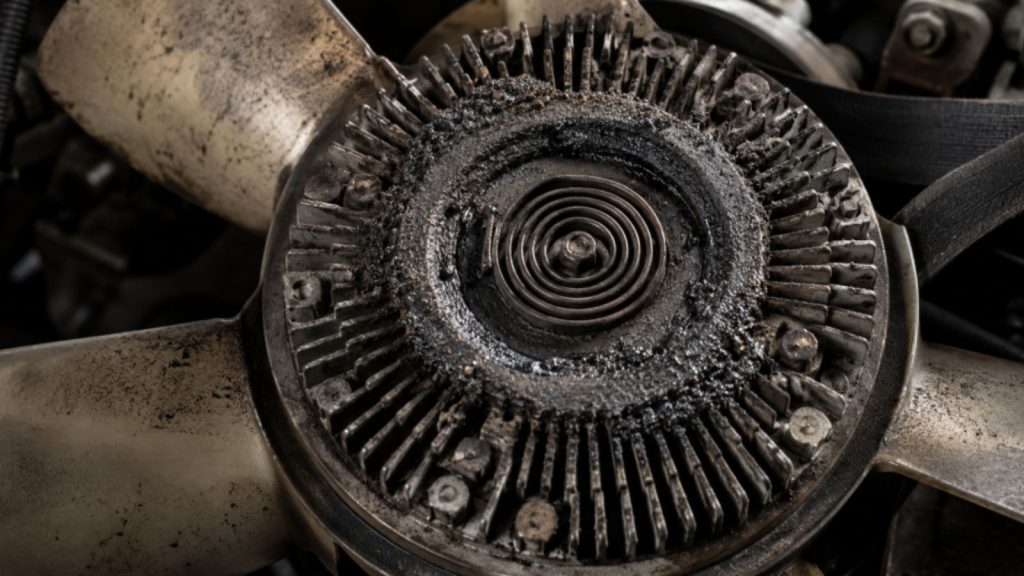
Sustained operation under intense South Texas sun exposure introduces a severe thermal load directly into the engine bay of modern passenger vans. When a vehicle transitions from the steady ram-air cooling of Loop 410 into a slow-moving queue, the cooling system relies entirely on the mechanical fan clutch to draw air through the condenser. A healthy viscous clutch uses a internal silicone fluid reservoir to lock up, matching the engine speed to pull crucial cubic feet per minute of air. However, when a clutch begins to fail, the slippage duty cycle rises dramatically to a range of +50% to +70%. This means the water pump pulley is spinning at full speed, but the fan blades are lazily drifting, leaving the radiator completely starved of localized airflow while the sun beats down on the hood.
Diagnostic Verdict: Optical tachometer verification recorded fan clutch slippage at 62% under sustained load, confirming a complete failure to lock up at operating temperature.
Low-Velocity Park Entry Idling and Thermal Heat Soak Failures
Idling on expansive blacktop parking plazas during a 102°F afternoon outside SeaWorld San Antonio creates an environmental micro-climate with ground-radiant temperatures exceeding 140°F. This superheated air is drawn directly up into the lower engine compartment, eliminating the temperature differential required for the radiator to shed heat. Without a functional fan clutch to force a high-velocity airflow stream across the core, thermal heat soak takes over. The high-side refrigeration pressures within the adjacent air conditioning condenser spike rapidly. This forces a vent discharge delta split exceeding 25°F between the front and rear evaporators, causing the passenger cabin to blow warm air minutes before the engine’s coolant jackets reach a critical boiling point.
Diagnostic Verdict: Digital manifold gauges recorded an immediate high-side pressure spike to 380 PSI during simulated low-velocity indexing, proving a lack of heat dissipation at the condenser.
Silicon Fluid Degradation and Fan Clutch Bimetallic Spring Fatigue
The mechanical core of a heavy-duty viscous fan clutch relies on a front-mounted bimetallic spring that expands and contracts based on the air temperature exiting the radiator core. This bimetallic loop is factory-calibrated to activate between 165°F and 175°F, turning an internal valve plate to shear specialized silicone fluid into the working fluid chamber. Over years of extreme South Texas heat cycles, this spring suffers from metallic fatigue, losing its tension and delaying valve opening. Concurrently, the high internal shear forces degrade the silicone fluid itself, permanently reducing its viscosity. The fluid thins out, losing its ability to transfer mechanical energy from the input shaft to the outer fan housing, resulting in a silent drop in engine airflow.
Observing the Visual and Sensory Indicators of a Blown Fan Fluid Seal
Master technicians check for internal fluid degradation by inspecting the front face of the fan clutch assembly for a dark, circular ring of accumulated road grime and dust. Because the viscous silicone fluid is highly clear and greasy, any seal compromise allows it to weep outward across the bimetallic coil. The sticky residue captures passing San Antonio Oak pollen and dirt, forming an insulating blanket over the bimetallic spring that further delays thermal activation and drops static cooling performance.
Diagnostic Verdict: Physical inspection revealed a complete loss of viscous fluid through the front assembly seal, leaving the bimetallic spring coated in a thick layer of grit that prevented mechanical activation.
Post-Isolation Performance Testing and Fleet Idle Restoration
Restoring a multi-passenger van’s low-speed cooling capability requires isolating the fan assembly and testing its physical performance testing parameters against original factory specs. We install a brand-new, heavy-duty thermal clutch unit and utilize a digital anemometer to measure real-time air velocity directly through the center of the radiator core at idle. A successful service must restore airflow velocity back to a stable target range of 800 FPM to 1,200 FPM. This ensures that whether a family van is traveling at highway speeds or crawling through low-velocity parking queues, the engine block remains safely within its operating thermal boundaries.
Diagnostic Verdict: Post-replacement diagnostic testing confirmed air velocity across the radiator core reached 1,050 FPM at idle, fully restoring the system’s low-velocity thermal capacity.
Drivers can have their van’s fan clutch health and airflow metrics validated at Ruben’s Auto Repair, 7210 Polar Bear, San Antonio, TX 78238, before entering the peak summer travel season.
Frequently Asked Questions
Why does my van’s AC stop blowing cold air when idling in amusement park lines?
Yes, a slipping fan clutch drops airflow below 400 FPM, spiking condenser pressures and causing the air conditioning to blow warm air at a standstill.
Can a bad fan clutch cause my engine to overheat without any warning lights on the dash?
Yes, a degraded clutch allows engine temperatures to climb steadily from 205°F to 235°F during extended idling before a dashboard warning triggers.
What is the greasy dirt ring found on the front of a cooling fan clutch assembly?
Yes, a dark ring of oil and dirt confirms that the internal silicone fluid seal has ruptured, destroying the clutch’s mechanical ability to lock up.
Does parking my vehicle in the hot San Antonio sun damage the engine cooling fan?
Yes, prolonged radiant heat cycles fatigue the front-mounted bimetallic spring, delaying the clutch activation past its factory 165°F thermal threshold.
Should the front and rear AC vents blow at different temperatures when the fan clutch fails?
Yes, low airflow across the condenser forces an immediate vent discharge split exceeding 25°F between the front and rear cabin zones.