Your brakes do not work alone. They rely on the suspension, steering, tires, and alignment to put stopping force to the road, so when those parts wear, they can create shaking, pulling, clunks, or unstable stops that feel exactly like brake problems. That is why replacing brake parts alone does not always fix the complaint, and why we inspect these related systems together, not in isolation.
Your Brakes Depend on More Than the Brakes
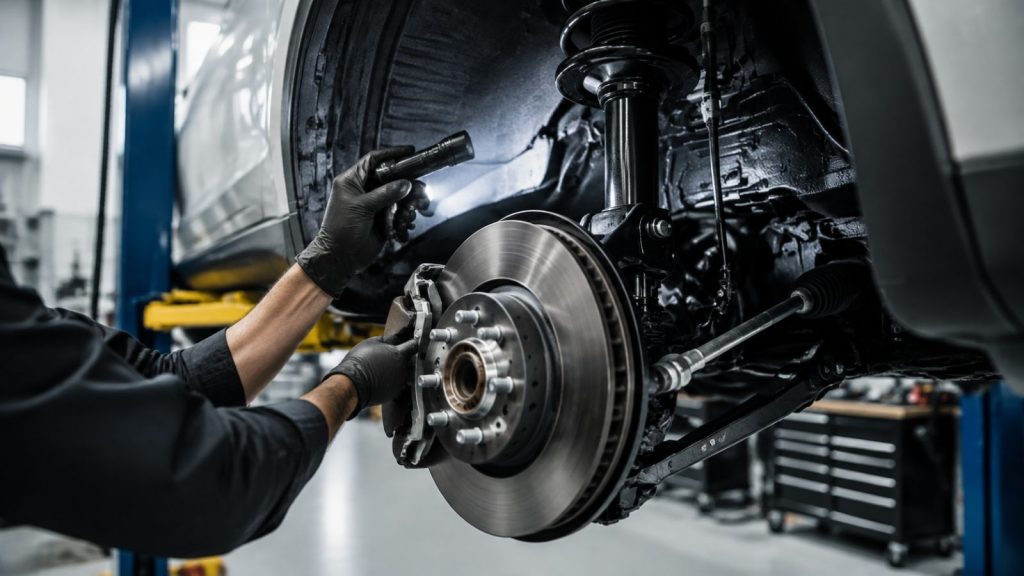
When something feels off while stopping, the brakes get the blame. That makes sense, because stopping is their job. But the brakes are only one part of a chain, and every link in that chain affects how the car feels when you slow down.
Think about what actually happens when you brake. The brakes clamp the rotors and slow the wheels. The suspension controls how the car settles and stays planted. The steering keeps everything pointed straight. The tires are the only thing touching the road, so every bit of stopping force has to pass through them. If any of those supporting parts is worn, the stop can feel wrong even when the brakes themselves are perfectly healthy.
That is why we do not look at the brakes in isolation. When a brake complaint does not quite add up, the parts around the brakes are often where the real answer is hiding.
When Worn Shocks and Struts Make Stops Feel Wrong
Shocks and struts do not stop the car, but they control how the car behaves while it stops, and worn ones change that feel in a way drivers often read as a brake problem.
When you brake, the car’s weight shifts forward. Good shocks and struts keep that weight transfer controlled, so the nose dips a little and settles. When they are worn out, that forward dive becomes exaggerated. The front end plunges, the rear feels light, and the whole stop feels unstable or longer than it should, especially in a hard stop.
A driver feels that instability and assumes the brakes are struggling. In reality the brakes may be gripping fine, but the suspension is no longer controlling the car’s motion through the stop. Fresh pads will not fix that, because the pads were never the problem.
The Noises and Shakes That Are Not the Brakes
Some of the most common brake complaints are actually noises and vibrations coming from worn suspension and steering parts, not the brakes at all.
A failing wheel bearing is a classic example. It can create a droning or grinding noise and a vibration that changes with speed or when you turn, and that is easy to mistake for a brake noise or a warped rotor. A vibrating brake pedal has its own set of suspects worth sorting through, but a bad bearing can produce a very similar feel from a completely different part of the car.
Worn steering and suspension joints do the same thing. Loose tie rods, worn ball joints, or tired bushings have play in them, and braking forces expose that play. The result can be a shimmy, a clunk, or a wandering feel as you slow down. We would rather find the worn suspension part than sell a brake job that leaves the complaint in the car. Worn joints can be checked for the play that produces these brake-like symptoms, which is exactly why the inspection reaches past the brakes.
When the Car Pulls but the Brakes Are Fine
A car that pulls to one side while braking feels like a brake problem, and sometimes it is. But two non-brake causes belong on the list, and both are easy to miss.
Alignment is the first. When a vehicle is out of alignment, it can drift or pull, and that pull can show up or worsen under braking. The alignment itself does not usually create the pull directly during braking, but the uneven tire wear it causes certainly can. A wheel alignment service sometimes turns out to be part of the answer to what looked like a pure brake complaint.
Tires are the second. A difference in tire condition or pressure from one side to the other changes how each side grips, and that can pull the car. Since a pull under braking has its own fuller list of possible causes, the point here is simply that the brakes are not automatically the culprit. The car pulling does not prove the brakes are at fault.
Why New Brakes Alone Sometimes Do Not Fix It
Here is the idea that ties all of this together, and it explains a frustrating experience a lot of people have had. Someone pays for new brakes to fix a shake, a pull, or an unstable stop, and the complaint is still there afterward.
The reason is that stopping force travels a path. It starts at the brakes, but it moves through the suspension and steering and finally reaches the road through the tires. If the real weak link is a worn strut, a bad bearing, a loose joint, or a bad alignment, then replacing the pads and rotors fixes a part that was not broken. The fresh brakes cannot compensate for a worn chassis, because the problem was never in the brakes to begin with.
That is why we inspect these systems together. A stopping problem is not always a brake problem, and a proper brake inspection that also considers the suspension, steering, and tires is what keeps you from paying for the wrong repair. If a worn suspension part is the true cause, then suspension repair is what actually resolves the complaint.
Not Sure If Its Your Brakes or Something Else
If your car shakes, pulls, clunks, or just feels unstable when you stop, and you are not sure whether it is really the brakes, we can look at the whole picture rather than just the pads. The goal is to find the actual cause, brake or otherwise, so you fix the right thing once. You can call the shop at (210) 647-1148 and we will help sort it out.
Frequently Asked Questions
Can suspension problems feel like brake problems?
Yes, often. Worn shocks and struts can make stops feel unstable, a bad wheel bearing can mimic brake noise or vibration, and loose steering joints can cause shimmy or clunks under braking. Because the brakes rely on these parts to work, a worn one can easily feel like a brake fault when it is not.
Can worn shocks affect braking?
They can affect how braking feels and how stable the car is while stopping. Shocks and struts control the weight transfer when you brake, so when they are worn, the front end dives more and the stop feels less controlled. The brakes may be fine, but the car’s behavior during the stop suffers.
Why did new brakes not fix my problem?
Because the real cause may have been outside the brakes. Stopping force travels from the brakes through the suspension and tires to the road, so if a worn strut, bearing, joint, or bad alignment is the source, new pads and rotors will not resolve it. That is why the related systems are worth inspecting before replacing brake parts.
Should suspension be checked during a brake inspection?
It is a good idea when the complaint could come from either system. A thorough inspection may include the suspension and steering, not just the brakes, because symptoms like shaking, pulling, and unstable stops can originate in those parts. Checking them together helps make sure the actual cause gets found and fixed.