Connected Subaru systems transmit real-time diagnostic data and service notifications, sometimes ahead of a dashboard warning light. Remote monitoring covers a defined parameter set, not the full scope of an in-person scan. Your car tracks how you drive to change its service dates. We never start a repair based on a software notification alone. A pro always checks the hardware first.
What Real Time Diagnostics Actually Send to a Connected Subaru Owner
Your Subaru talks back to the factory. It reveals much more than a simple GPS location. Stored codes and certain sensor values reach the manufacturer app directly.
Connected alert volume across the shop’s customer base concentrates heavily on the same few systems. Drivers see CVT, cooling, and battery warnings pop up most frequently. These issues make sense given how poorly this specific system handles high temperatures and heavy stop and go traffic.
That concentration isn’t random. Systems already prone to heat-driven trend issues are exactly the ones generating the most connected alerts.
Official Health Conclusion. Our initial review of the alert logs showed that CVT and cooling system issues popped up way more often than anything else on our list.
How Service Notifications Differ From a Dashboard Warning Light
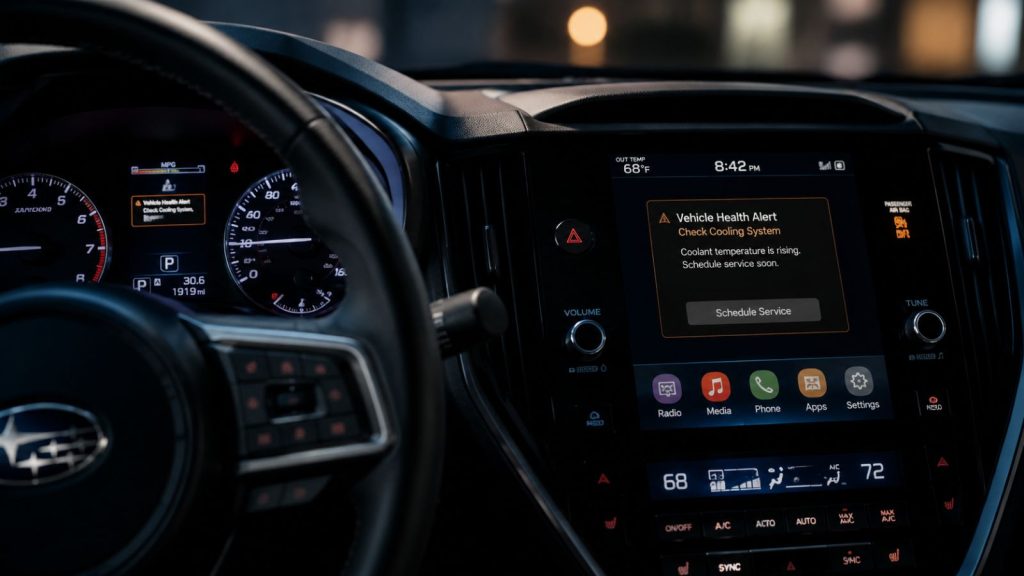
Standard OBD-II logic monitors vehicle data. If a specific measurement climbs too high or drops too low, the dashboard light pops on. Expect those connection updates to land a bit early.
Notification logic can draw on trend data or scheduled interval logic, not just a single threshold crossing. You might get a notification through the app before your car even registers a problem on the instrument cluster.
Getting this heads-up early lets an owner book a mechanic right away. It beats waiting for a dashboard light to pop up and ruin your day.
The Official Assessment. A connected service notification arrived on one vehicle several days before the corresponding dashboard warning light activated for the same condition.
What Remote Monitoring Can and Cannot Catch
Many people mistake a simple dashboard notification for a complete mechanical report. The records suggest a tight focus. However, we still have to verify those claims to be sure.
Sensors pick up certain measurements and report them back instantly. It doesn’t retrieve the full diagnostic data a shop-connected scan tool pulls during an in-person visit, and it can’t physically inspect a component.
Since a vacuum exists between detection and action, these alerts fill the void. They start the conversation. They do not finish it for you.
Your formal exam results. A connected alert flagging a general system category was narrowed to a specific component only after a full in-person scan tool connection.
How Driving Behavior Shapes Connected Maintenance Scheduling
Your car monitors your habits and shifts repair dates to match your actual road use. That’s a similar principle to the condition-based tracking covered separately in this cluster, just generated automatically instead of through shop-side monitoring.
We look at your real habits behind the wheel rather than following a rigid maintenance plan. Two vehicles with the same odometer reading can get different suggested timing based on how each was actually driven.
These automatic shifts don’t push aside your shop’s own trend monitoring. Think of them as a fresh set of eyes providing extra numbers for your strategy.
The Official Assessment. Connected scheduling suggested an earlier service window on a heat and traffic exposed vehicle compared to the standard fixed interval for the same mileage.
How Ruben’s Auto Repair Uses Connected Alert Data During a Service Visit
Intake visits triggered by a connected alert follow a pretty consistent path once the vehicle is actually on the lift. The alert data starts the conversation, not the diagnosis.
Link your Subaru to Ruben’s Auto Repair for fast electronic troubleshooting. Your technician first examines the data you brought along. Then, a hands-on inspection and digital scan help us pin down the exact cause of the trouble.
You have to double check the data no matter which platform sent the first notification.
Final medical finding. Every alert we received this year led to a deep scan. We also did a physical walkthrough before we ever told a client how to fix the issue.
Bring In Your Connected Alert for a Full Confirmation
Subaru owners who received a connected service alert can call or schedule a visit with Ruben’s Auto Repair, 7210 Polar Bear, San Antonio, TX 78238, at (210) 647-1148, to confirm what that alert actually means before any repair.
Frequently Asked Questions
Do connected Subaru alerts arrive before the dashboard warning light?
Predictive alerts find problems while they are still small. They notify you before the equipment crosses a hard failure line.
Does remote monitoring see everything a shop scan tool would find?
No, remote monitoring covers a defined parameter set, not the full scope of an in-person scan.
Can driving behavior really change suggested Subaru maintenance timing?
Yes, connected systems can adjust scheduling based on logged driving patterns rather than mileage alone.
Is a connected alert enough information to authorize a repair?
Even if you get a digital notification, a technician still looks at the machine before fixing it.
Do all connected alerts follow the same confirmation process at the shop?
We treat every hit the same way. The process always moves to a comprehensive search after the system flags a problem.