AC diagnosis traditionally relies on a single visit’s findings plus whatever the owner remembers or a paper file contains. Complete digital service records enable trend analysis of refrigerant charge, repair history, and component wear across a vehicle’s lifespan. This matters especially in San Antonio, where sustained heat accelerates wear on a predictable but only trackable timeline.
A single diagnostic visit tells us where a system stands right now. What it can’t tell us, on its own, is where that system was six months ago or whether today’s reading represents a stable system or one that’s been quietly sliding for a while. That distinction matters a lot more than people usually think, and it comes down almost entirely to whether good records exist.
Why a Single Visit Never Tells the Whole Story
Refrigerant charge at 88 percent of spec sounds like one number, but it means something completely different depending on what came before it. A vehicle that’s held steady around 95 percent for two years and just dipped slightly is a different situation than one that’s dropped from 98 down to 88 over the past six months. Same number today, very different trajectory, and only one of those situations needs urgent attention.
Paper records or service history scattered across different shops make that kind of comparison nearly impossible. Every visit ends up starting from zero, treated as its own isolated snapshot rather than one point on a longer trend line. That’s a real limitation, and San Antonio’s climate makes it a bigger one than it would be somewhere milder, since sustained heat here pushes components toward wear on a timeline that’s genuinely predictable, if you have the data to actually see it.
How We Actually Use Historical Data in Diagnosis
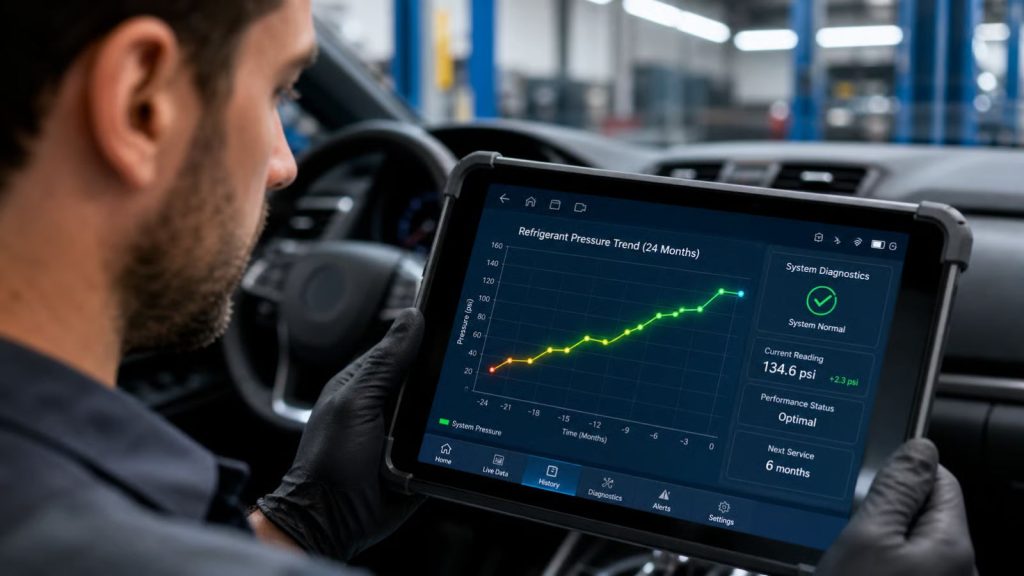
We don’t just check today’s numbers against a manufacturer spec sheet. We check them against that specific vehicle’s own history.
Current refrigerant charge gets compared against every previous reading we have on file for that vehicle, not just the ideal spec number. A reading sitting at 88 percent means something different depending on whether it held steady near spec for years or arrived there through a steady multi month decline.
We also track when components were actually replaced and weigh that against what we know about San Antonio specific wear patterns. A compressor or seal replaced three years ago carries a different risk profile here than the same age component would in a region with a shorter, milder heat season, but that context only has value if the replacement date is actually recorded somewhere we can access it.
Every visit gets logged in a way that builds toward an actual trend rather than sitting as a standalone report. A marginal reading that shows up on one visit alone tells us relatively little. The same marginal reading showing up again on the next visit, and the one after that, tells a real story worth acting on.
Why We’d Rather Build a Real History Than Start Over Every Visit
A vehicle with a genuinely complete service history gets diagnosed more accurately, full stop. Trends that a single isolated visit would completely miss become visible once there’s actual data to compare against. That accuracy is the difference between catching something at the early, low cost stage versus catching it only once it’s progressed into an actual breakdown, and in a climate where wear follows such a predictable pattern, good records are honestly one of the more underrated tools we have.
Get Your Digital Service History Started or Updated
If you want your vehicle’s AC diagnostics to actually account for its full history instead of starting fresh every visit, we can help build or properly incorporate that record. Schedule an AC inspection with Ruben’s Auto Repair, 7210 Polar Bear, San Antonio, TX 78238, (210) 647-1148, keeps this kind of record for our regular customers.
Frequently Asked Questions
Why does having a digital service history actually matter for AC diagnosis specifically?
AC systems degrade gradually in most cases, and a trend, refrigerant charge slowly declining or cycling frequency slowly increasing, is only visible if there’s historical data to compare the current reading against.
What if I’ve had my AC serviced at multiple different shops over the years?
Fragmented history across shops makes trend analysis harder, though we can incorporate whatever records you do have and start building a more complete picture from your next visit forward.
Does San Antonio’s climate really change how much this matters compared to elsewhere?
Yes. Sustained heat accelerates component wear on a fairly predictable timeline here, which makes historical trend data more valuable than it would be in a milder climate where components degrade more slowly and less predictably.
How far back does a service history need to go before it’s actually useful?
Even a couple of prior visits provide meaningful comparison value. The usefulness grows the more consistent and complete the record becomes over time.
Will this cost extra compared to a normal AC inspection?
No. Maintaining a digital service record is part of how we document any inspection or repair, it does not add a separate cost, it simply makes future visits more informed.