Digital HVAC service records capture evaporator outlet temperature, blower motor amp draw, cabin filter static pressure, and refrigerant charge at each visit. In San Antonio July heat, a documented baseline reading from a prior visit compresses diagnostic time and confirms system drift before the driver notices reduced cooling.
What Does a Digital HVAC Service Record Actually Contain?
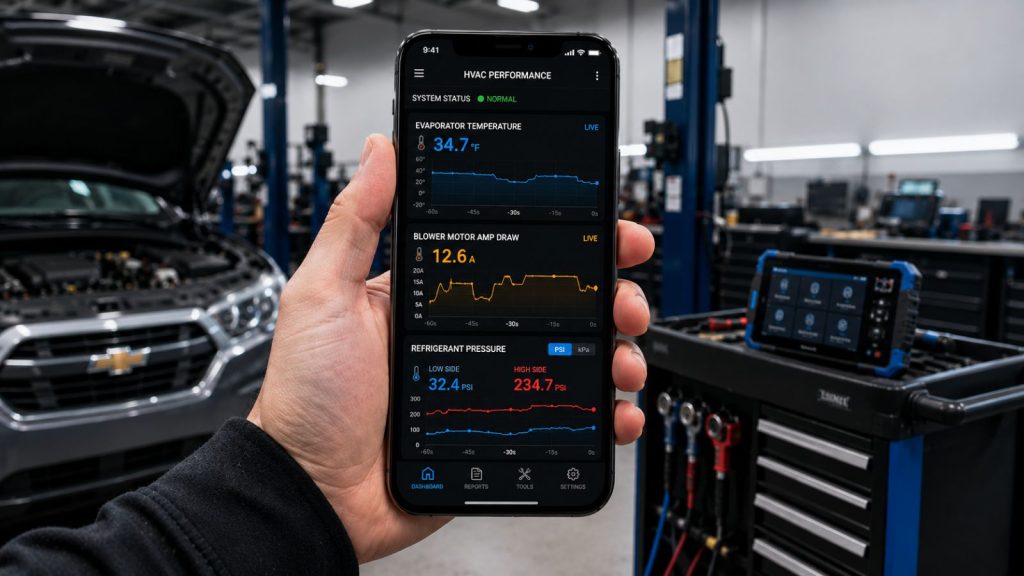
A digital service record is not a receipt. It is a documented set of measured system values captured at the time of service and sent directly to the vehicle owner’s phone.
The Heating and Cooling Services records maintained at Ruben’s include evaporator outlet temperature readings, blower motor amp draw, cabin filter static pressure, and refrigerant charge PSI. Each value is recorded against the date and vehicle mileage. The result is a longitudinal thermal profile, not a single snapshot.
Paper records get lost in gloveboxes or left at home. A digital record tied to the owner’s phone is present at every visit, readable by the technician in under 60 seconds, and comparable against the new readings taken that day.
Diagnostic Verdict: A complete digital HVAC record covering three or more visits allows the technician to identify refrigerant charge drift of 6 to 10 PSI and blower motor amp draw progression of 2 to 4 A above baseline before either condition produces a driver-reported symptom.
Evaporator Temperature and Refrigerant Charge: Why Baseline Data Matters
Evaporator outlet temperature is the most direct indicator of system health. A properly charged system in San Antonio July ambient of 102°F to 108°F produces an outlet reading of 38°F to 45°F. A reading of 50°F to 55°F at the next visit, with no other complaint, confirms early refrigerant loss.
Without a documented prior reading, a 52°F evaporator outlet reading requires the technician to determine whether this is the vehicle’s normal operating range or a deviation. With a documented baseline of 41°F from the previous visit, the 11°F drift is a confirmed finding. Diagnosis moves directly to leak detection.
In vehicles we service from the Lackland AFB and Fort Sam Houston corridors, we consistently find evaporator outlet temperature drifting 8°F to 12°F above the documented baseline by the time the driver schedules the next appointment. These vehicles run HVAC at maximum demand during high-idle gate and post-shift periods in sustained July heat. The digital record converts what would be a two-step diagnostic process into a confirmed finding at first inspection.
Diagnostic Verdict: Vehicles presenting with a documented evaporator outlet baseline of 38°F to 45°F and a current reading of 50°F to 55°F confirm active refrigerant loss without requiring the driver to describe symptom onset or duration.
How Documented Blower Motor Readings Change the Next Diagnostic Visit
Blower motor failure rarely announces itself cleanly. A healthy motor at full load draws 8.5 A to 11.5 A. Early bearing wear pushes draw to 13 A to 16 A before audible symptoms appear. The difference between those two ranges is the difference between a scheduled replacement and a roadside failure.
Many drivers assume HVAC service records are only useful for warranty documentation or resale value. The diagnostic reality is different. A blower motor amp draw of 9.2 A documented at one visit, followed by 13.5 A at the next, confirms progressive bearing failure before any noise develops. Without the prior documented value, a reading of 13.5 A is ambiguous. It could reflect a failing motor or a sustained high-demand operating condition. The documented baseline removes that ambiguity in seconds.
This is not a minor efficiency gain. A confirmed progressive amp draw trend authorizes a motor replacement conversation the driver can understand and verify. A single unexplained high reading requires more diagnostic steps before the same conversation can begin.
Diagnostic Verdict: Blower motor amp draw progression from a documented 9.2 A baseline to a current reading of 13.5 A confirms bearing degradation and places the motor within the 13 A to 16 A pre-failure range, independent of audible symptom onset.
Cabin Filter Static Pressure History in San Antonio Pollen Conditions
San Antonio Oak pollen season runs March through May. A clean pleated cabin filter reads 0.18 to 0.22 inH2O at baseline. A pollen-loaded filter at replacement threshold reads 0.50 to 0.60 inH2O. The gap between those two readings can close in 30 days during peak season.
In vehicles we service from Stone Oak and Shavano Park, the pattern we see most consistently during March through May is cabin filter static pressure reaching 0.50 to 0.60 inH2O within 30 days of a documented clean-filter baseline. These vehicles travel Hwy 281 daily through peak pollen corridors. Without the prior documented static pressure reading, the driver’s complaint of reduced airflow requires a full baseline measurement before any diagnosis can proceed. With the documented reading, the technician confirms the delta immediately.
The standard replacement interval of 12,000 to 15,000 miles was written for temperate climates with moderate particulate loads. In Bexar County during Oak season, that interval produces six to eight weeks of operation on a filter working at 40% capacity. A digital record showing documented static pressure readings gives the technician the evidence needed to recommend an interval adjustment the driver can see and verify on their own phone.
Diagnostic Verdict: Cabin filter static pressure documented at 0.18 to 0.22 inH2O at a prior visit and measured at 0.50 to 0.60 inH2O at the current visit confirms a replacement need independent of mileage interval, with the delta visible to the driver in the digital record.
What San Antonio Drivers Can Do With a Complete Thermal Service History
A complete thermal service history changes the ownership experience. It is not a passive document. A driver who can show a technician three visits of documented refrigerant charge readings, evaporator outlet temperatures, and blower motor amp draw values is a driver whose vehicle gets diagnosed faster and repaired more accurately.
For vehicles making the Helotes to San Antonio run on I-10, or the Leon Valley commute on Hwy 151, sustained highway thermal load places consistent demand on condenser airflow. A documented CFM reading from a prior visit, compared against a current reading of 600 to 700 CFM from a condenser with 20% to 30% fin blockage, identifies degradation that a visual inspection alone may miss. The digital record makes that comparison possible without relying on the driver’s recall.
The practical outcome is shorter diagnostic visits and fewer repeat appointments. A technician working from three visits of documented readings spends time confirming and repairing, not establishing baseline measurements from scratch.
Diagnostic Verdict: A three-visit digital HVAC record covering evaporator outlet temperature, blower motor amp draw, and refrigerant charge PSI reduces baseline measurement time at each subsequent visit and allows deviation confirmation within the first 10 minutes of the diagnostic session.
Drivers can schedule an HVAC diagnostic and start building a digital thermal service history at Ruben’s Auto Repair, 7210 Polar Bear, San Antonio, TX 78238. Call the shop or book an appointment online at rubensautocare.com before July heat creates a gap in the record that costs time at the next visit.
Frequently Asked Questions
What information is included in a digital HVAC service record?
Yes, a complete digital HVAC record includes evaporator outlet temperature, blower motor amp draw, cabin filter static pressure, and refrigerant charge PSI documented at each visit.
Can a digital service record help find an AC problem faster?
Yes, a documented evaporator outlet baseline of 38°F to 45°F allows a technician to confirm refrigerant loss from a 50°F to 55°F current reading without additional baseline testing.
Does San Antonio Oak pollen make cabin filter records more important?
Yes, static pressure documented at 0.18 to 0.22 inH2O can reach 0.50 to 0.60 inH2O within 30 days during March through May Oak pollen season in Bexar County.
Can a blower motor problem be caught early with service records?
Yes, progressive amp draw increase from a documented 9.2 A baseline to 13.5 A confirms bearing degradation before audible failure symptoms appear.
Does a digital service record help with refrigerant leak diagnosis?
Yes, a documented refrigerant charge drop of 6 to 10 PSI between visits confirms an active micro-leak without requiring the driver to describe symptom onset.