Fleet vehicles showing gradual cooling loss on Culebra Road delivery routes point to compressor fatigue from sustained duty cycle stress, not a single failure. Frequent stops and daily heat exposure push compressors past their rated rest cycle. Capacity below 85 percent of spec or a 3 to 5 degree vent temp rise over 90 days confirms wear needing inspection.
Pull last quarter’s cooling numbers against this quarter’s and the gap is real. Nothing broke overnight. This is compressor fatigue, one Culebra Road delivery day at a time, adding up until the trend becomes impossible to ignore.
The Duty Cycle Nobody Designed For
Compressors get rated around an assumption. Rest between operating periods. A personal vehicle mostly lives inside that assumption without anyone thinking twice, drive somewhere, park, cool down, repeat tomorrow.
A Culebra Road route doesn’t work that way. Frequent stops mean the compressor barely gets a true idle down between engagements. Sustained engine operation across a full shift keeps it working for hours straight. Layer daily heat exposure on top, month after month, and the total load a delivery vehicle carries has almost nothing in common with how these systems were tested and rated.
That gap is where the fatigue lives. Pistons or scroll components wear faster under constant repetition, whichever type the compressor uses, and the shaft seal takes the same hit right alongside them. None of it announces itself. It just shows up as slightly weaker cooling this month than last month, then weaker again the month after.
We tell fleet managers this early, because it matters. One vehicle declining slowly is easy to normalize, you adjust without realizing you’ve adjusted. Pull up a baseline from six months back and the trend jumps out immediately, usually across more than one truck running the same route.
What the Trend Line Actually Shows
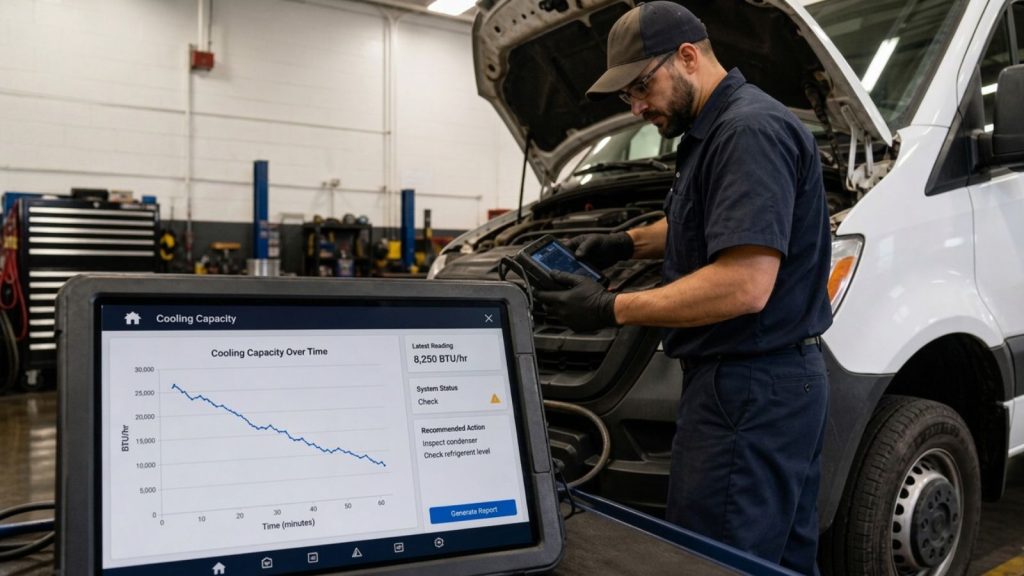
Current cooling capacity against baseline spec is where we start. Below 85 percent of rated capacity inside two years of fleet service, and we’re not looking at typical aging anymore.
Vent temperature at a fixed point in the shift, tracked across a rolling 90 days, turns that single snapshot into an actual trend. A 3 to 5 degree climb over that window under similar ambient conditions is a real signal, not noise from one hot Tuesday.
Cycling frequency across a full route rounds it out. Cross 40 to 50 compressor engagements in a single day, well past anything a personal commute would generate, and now we can put a number on exactly how much stress that vehicle is absorbing against what it was built for.
None of this responds to a recharge. The wear is mechanical, sitting inside the compressor itself, not a refrigerant level problem. Left alone across a fleet running identical routes, capacity loss tends to hit several vehicles around the same window, and what could have been a handful of scheduled repairs turns into a fleet-wide replacement bill all at once.
Get a Baseline Reading Before Wear Spreads Across Your Fleet
If your delivery fleet is showing gradual cooling loss on Culebra Road routes, we can establish a baseline and track capacity before the wear compounds across multiple vehicles. Schedule an AC inspection with Ruben’s, 7210 Polar Bear, San Antonio, TX 78238, (210) 647-1148, works with fleet accounts on this regularly.
Frequently Asked Questions
How is fleet AC wear different from a normal AC problem?
It comes from a duty cycle far beyond personal driving, constant stops, sustained running time, and daily heat exposure. The result is gradual capacity loss instead of one clean point of failure.
Can this be fixed with a simple recharge?
No. The wear sits inside the compressor mechanically, not in the refrigerant charge, so topping it off does nothing for the underlying problem.
How would I know if more than one vehicle in my fleet is affected?
Check cooling capacity against the baseline across the whole fleet, not just one truck. Vehicles running the same route tend to show a similar decline since they’re absorbing similar stress.
Is there a way to slow this kind of wear down?
Regular inspection catches the decline early, though the route itself will always demand more from the compressor than a personal vehicle ever would. You’re managing it, not eliminating it.
What happens if this goes unaddressed across the fleet?
Several vehicles tend to hit meaningful capacity loss around the same time, since they share route conditions, turning what should have been individual repairs into one large fleet wide bill.