AC cooling that cuts in and out specifically at Bandera Road stoplights points to compressor relay fatigue, not refrigerant loss. Repeated engagement cycling under high heat pits and oxidizes the relay’s contact points, raising resistance. Readings above 1.5 ohms at the contact points or current spikes past 6 amps at engagement confirm relay wear needing inspection.
Your AC cuts in and out right at Bandera Road stoplights, then runs fine once traffic clears and you’re moving again. That pattern points to the compressor relay, not the refrigerant charge, and San Antonio heat combined with stop and go cycling is exactly what wears it down.
How Stoplight Cycling Wears Out Your Relay
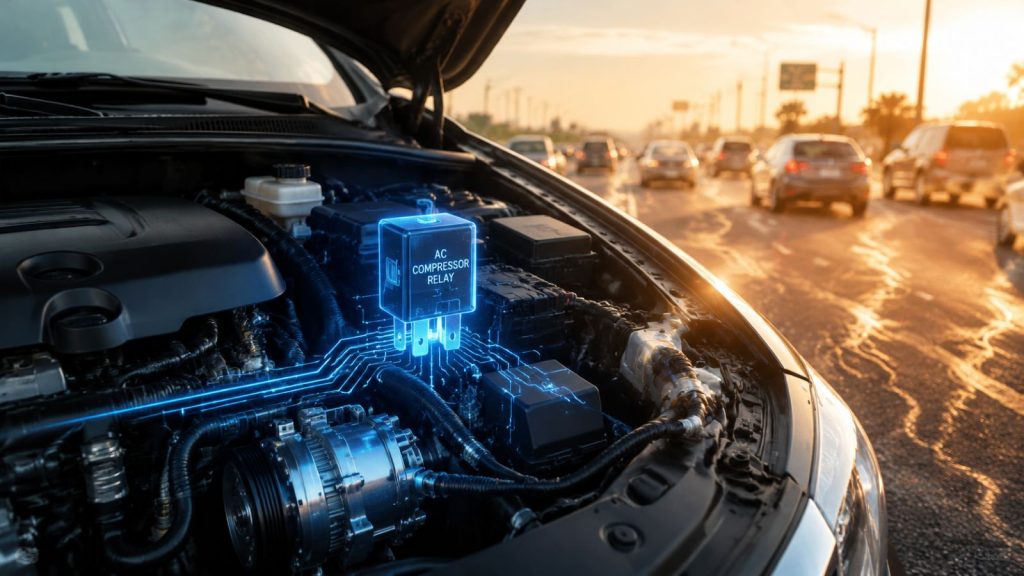
Under normal conditions, the compressor relay opens and closes an electrical circuit every time the compressor clutch needs to engage. It uses a low current control signal to switch a much higher current load, which keeps that heavier load from passing through the switch controls directly.
Bandera Road stoplight congestion doesn’t let that relay settle into a steady rhythm. Every stop forces the compressor to cycle on and off in short intervals, and San Antonio’s ambient heat adds thermal load to the relay housing right on top of the electrical load from each switching event.
That combination is what breaks the relay down over time.
Repeated switching under heat causes the relay’s internal contact points to pit and oxidize from arcing at each engagement. This buildup increases contact resistance, which raises heat at the contact surface itself, and enough cycles corrode the points to the point where engagement becomes inconsistent or fails intermittently, exactly the cutting in and out you’re feeling at every red light.
Shop note. We hear this complaint a lot from Bandera Road commuters specifically because that corridor has some of the most frequent stoplight cycling in the area. If your AC only acts up at stops and never on the open road, that pattern alone tells us where to look first.
Diagnostic Numbers That Matter
We start by testing relay resistance across the contact points. It should read below 0.5 ohms when closed. When we see readings climb above 1.5 ohms, that tells us contact corrosion is increasing resistance at the switch point.
Current draw at compressor engagement should read within 3 to 4 amps for most systems. A draw spike above 6 amps at engagement tells us the relay is struggling to make clean contact.
We also track how many engagement cycles happen per mile of stoplight congestion compared to open road driving. When intermittent cutout ties specifically to high cycle frequency during congestion and doesn’t show up during steady highway driving, that confirms relay fatigue over other causes.
A relay left to fatigue through repeated Bandera Road stops doesn’t just cause occasional cooling loss. Continued arcing and contact corrosion can eventually cause the relay to fail completely, and depending on how the circuit is wired, that failure risk can extend to the compressor clutch coil itself. What starts as a low cost relay swap can turn into a larger repair if it’s left unaddressed.
Book Your AC Diagnostic Before the Relay Fails Completely
If your AC cuts out specifically at Bandera Road stoplights, we can test the relay before repeated stops turn intermittent cooling loss into a full system failure. Book an AC diagnostic at Ruben’s Auto Repair, 7210 Polar Bear, San Antonio, TX 78238, (210) 647-1148, and we will trace it back to the source.
Frequently Asked Questions
Why does my AC only cut out at stoplights and not on the highway?
That pattern points directly to the compressor relay struggling with repeated engagement cycling during stop and go traffic. Steady highway driving does not demand the same rapid cycling, which is why the issue does not show up there.
Is this a refrigerant problem instead?
Usually not. Refrigerant issues tend to cause steady weak cooling across all driving conditions, not an intermittent cutout tied specifically to stoplight cycling. A relay resistance test is what confirms the difference.
How long can I keep driving with this happening?
You can drive with it for a while, but continued arcing and corrosion at the contact points only gets worse. What starts as an intermittent annoyance can progress to complete relay failure over time.
Is a relay repair expensive?
A relay replacement on its own is a relatively low cost repair compared to most AC system components. The risk is in waiting too long, since failure can extend to the compressor clutch coil and turn into a larger repair.
Will this get worse in extreme summer heat?
Yes. Higher ambient heat adds thermal load on top of the electrical load from cycling, which accelerates the pitting and oxidation at the contact points. Summer months are when this issue tends to progress fastest.