
Symmetrical AWD holds a documented torque split range under normal driving, but real-time scan data reveals whether that distribution stays steady or drifts during an active drive cycle. Sustained heat exposure causes measurable drift compared to cold-start baseline. Testing while stationary only shows basic operation. It fails to catch the subtle slipping or drifting that happens once the vehicle hits the road.
Why Real Time Torque Data Matters More Than a Static Check
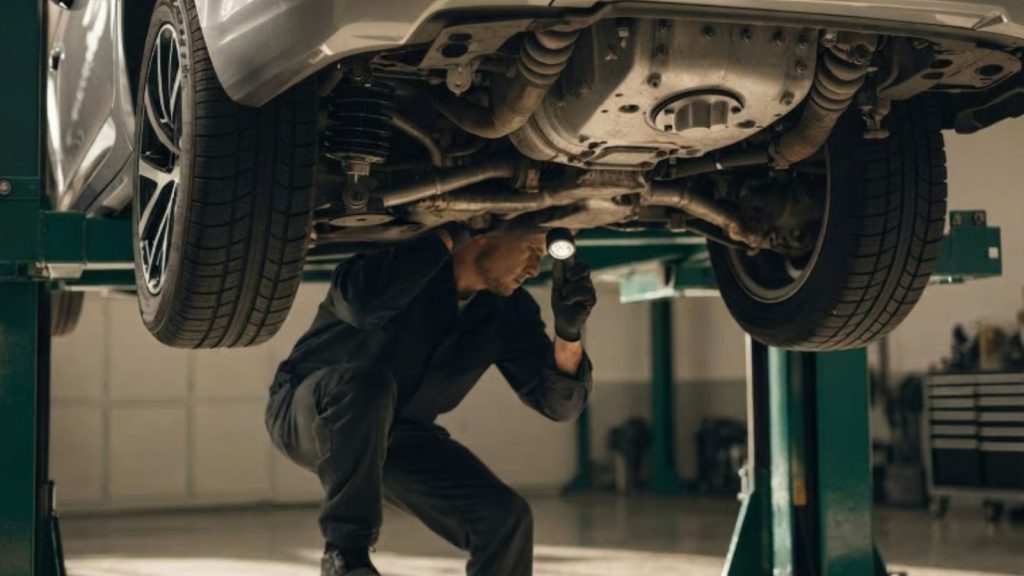
Hoisting the car reveals if the all-wheel drive system actually engages. These numbers mean nothing if the truck struggles under a full load. Real performance happens on the road.
Symmetrical AWD distributes torque within a documented front-to-rear ratio range during normal driving. Live scan data shows if your distribution stays solid or starts to wobble during a drive. A single static test misses these shifts because it only looks at one moment in time.
Even so, most diagnostic visits still start with a static check, since it’s faster. When a quick look doesn’t explain the error, watching the data flow live is your next move.
Our Clinical Decision. The AWD system looked fine in the shop, but we caught torque drift once we hit the road for a live test.
How We Actually Read Slip Detection Response on a Scan Tool
When one wheel loses traction, the AWD system should redistribute torque within a documented response window. Your software records every millisecond of delay right as it occurs.
The scan tool logs the exact moment slip is detected and how quickly torque redistribution follows. You need a response speed that hits the official factory specs. A quick lap around the block won’t tell you if the machine actually meets its requirements.
This data shows if the car actually followed its programming during a trip. It replaces a person’s gut feeling with clear evidence of how the vehicle was handled.
Official Test Results. We logged the traction response and found it hits the manufacturer targets. The hardware handled the stress well. Everything is working just like it did on day one.
What Heat Stress Does to Drivetrain Performance in Real Time
Every time we check the logs from those long summer road trips, that same torque wobble pops up. If the engine stays hot throughout the cycle, expect to see measurable calibration errors.
We measure this deviation against the first readings taken while the engine was still cold. Heat affects differential fluid viscosity, and that viscosity change alters how torque actually transfers between the front and rear axles under load.
Cold weather and short trips around town fail to show how the car actually performs. You won’t notice the shifting until the hardware sits in high heat for a while.
The Official Assessment. Real-time torque data on a vehicle logged during a 45 minute summer drive showed measurable drift from its cold-start baseline reading.
The Torque Distribution Pattern We See Most Under Sustained Heat
Recent logs from the Government Canyon area prove Post 11 had it right. These paths are punishing. They force all-wheel drive systems to work way too hard. Expect your slip sensors to go off much more often on dirt trails than on flat asphalt.
Vehicles logged during longer, sustained heat drive cycles show measurably more torque distribution variance than the same vehicles logged during short, cooler drives. You can count on these results whether you are on flat ground or rocky hills.
Mix constant sun with gravel roads and the damage multiplies much faster than you might expect.
The Official Assessment. Data from Government Canyon shows that summer heat causes tires to slip much more often on trails than on city streets.
When Real Time Data Points to a Drivetrain Repair
Keeping your torque delivery within these factory boundaries keeps the system running as the builder intended. Actual numbers frequently exceed the predicted range once you spend some time on the road in the San Antonio heat.
Seeing a bit of drift doesn’t always require an immediate fix. You know it is time for a fix when drift shows up across several trips or the slip response misses its mark every single time.
Ruben’s Auto Repair mechanics check your Subaru AWD system for issues. Rather than betting on one old test result, our evaluation watches live activity to see what is actually happening.
Final health assessment. A vehicle showing persistent torque drift across three separate logged drives was confirmed for differential service, distinct from a one-time reading that would not have warranted repair.
Get Real Time Data on Your Subaru’s AWD System
Subaru owners noticing anything off with AWD performance can call or schedule a real-time diagnostic drive with Ruben’s Auto Repair, 7210 Polar Bear, San Antonio, TX 78238, at (210) 647-1148, to see what a static check alone might miss.
Frequently Asked Questions
Can a static AWD check on a lift catch every problem?
You usually won’t see drift or slip reactions until the car is actually moving with a heavy load.
Does heat really affect real-time AWD torque distribution?
Keeping the hardware hot causes accuracy to slip. It creates a noticeable gap between active use and your first cold test.
Does unpaved terrain trigger AWD slip detection more than paved roads?
Expect your slip detection to kick in more often on loose gravel roads like the Government Canyon trailhead.
Does one instance of torque drift mean a repair is needed?
No, persistent drift across multiple logged drives is what actually points toward a repair decision.
Is real-time monitoring more accurate than a single test drive impression?
A scan tool gives you hard numbers on response speed so you can stop guessing based on how the car feels.