
San Antonio heat by itself does not ruin brake fluid. The bigger issue is moisture. Brake fluid slowly absorbs water, and that lowers its boiling point. When your brakes generate their own heat in stop and go traffic, fluid that is already saturated can boil sooner. That is why we look at fluid conditions and braking symptoms together, not the weather alone.
What Brake Fluid Actually Does in Your Brakes
Brake fluid is not just something that sits in a reservoir. It is the muscle between your foot and the wheels. When you press the pedal, that fluid transfers the force through the hydraulic brake system to the calipers, which squeeze the pads against the rotors.
The whole thing works because liquid does not compress. Push on one end, and the pressure moves through instantly. So the fluid has one job that never changes. It has to stay a solid, incompressible column no matter how hard the brakes are working.
That is the part most people never think about. And it is exactly the part that South Texas conditions can quietly wear down over time.
Why Heat Is Only Half the Story
Here is where the common assumption goes sideways. A lot of drivers think the summer heat in the parking lot is cooking the fluid inside the car. The pavement is hot, the hood is hot, so the fluid must be getting damaged. That sounds logical, but it is only part of the picture.
There are really two kinds of heat that matter, and they are not the same. There is the heat in the air around your vehicle, and there is the heat your brakes generate themselves every time you slow down.
The second one is the bigger deal. Think about a normal drive on Loop 410 or Loop 1604 in traffic. Stop, go, stop, go. Every one of those stops turns motion into heat at the friction surfaces, and some of that heat travels into the hydraulic system. Ambient heat raises the baseline, but the braking is what really loads the fluid. So when we hear “the Texas heat killed my brake fluid,” what we usually want to know first is how the fluid is actually doing, not what the thermometer said.
How Moisture Quietly Lowers the Boiling Point
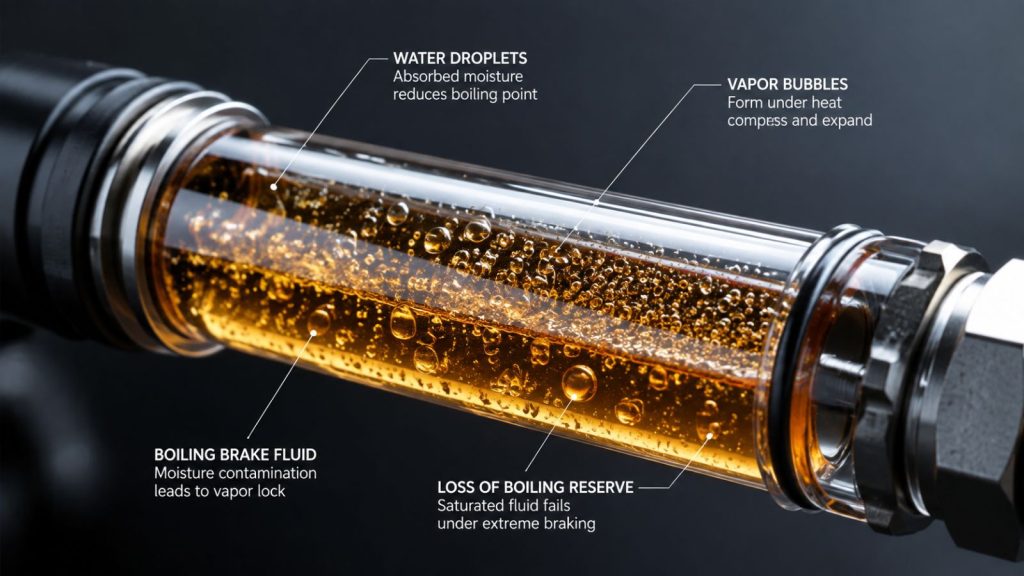
The real weak spot is moisture. Most brake fluid used today is glycol based, and glycol fluid is hygroscopic. That is a fancy way of saying it pulls water out of the air over time, even through seals and the reservoir cap. San Antonio’s humidity does not help here, because more moisture in the air means more moisture available for the fluid to absorb.
Why does a little water matter so much? Because water boils at a far lower temperature than brake fluid does. As the fluid absorbs moisture, its boiling point drops. Engineers call the safety margin its boiling reserve, and that reserve is what keeps the fluid liquid under hard braking.
When saturated fluid boils, it generates vapor. Unlike liquid, vapor compresses, causing a soft or spongy pedal as your foot pressure squeezes gas rather than displacing fluid. This dynamic is precisely why fluid standards matter. DOT 4 fluid has a higher minimum dry boiling point than DOT 3, but the right fluid for your vehicle depends on the manufacturer, so that is an owner’s manual question, not a one size fits all answer.
How We Approach Checking Brake Fluid Condition
This is where fluid color trips people up. You pop the cap, the fluid looks dark, and it seems obvious that it needs changing. But we do not make that call from color alone. Dark fluid gives us a reason to look closer. It does not tell us the moisture level or how much boiling reserve is left.
That distinction matters, because color and actual condition are two different things. Fluid can look clean and still be saturated with moisture, and fluid can look dark and still test within a usable range. What we want to know is the measured condition, not appearance.
So the useful evaluation looks past the reservoir. Brake fluid condition can be checked with a moisture or boiling-point tester, which gets at the thing that actually matters. A complete brake inspection may also include a look at the pads, rotors, hoses, and the rest of the hydraulic system, because a soft pedal is not always the fluid. It can be air in the lines, a failing flex hose, or a hydraulic issue upstream. That is the point of real brake diagnostics. We would rather confirm the cause than swap fluid on a hunch and leave the actual problem in the car.
Why It Helps to Catch This Early
None of this is about scaring anyone. It is about timing. Fluid condition changes slowly and quietly, which is exactly why it gets ignored until the pedal already feels different.
The trouble is that the boiling reserve does its most important work on the worst days. A tired column of fluid might feel completely normal on a short errand, then feel soft during heavy braking in summer traffic or on a longer descent out toward the Hill Country. That is the moment you actually need the margin, and it is the moment a saturated fluid is most likely to let you down.
Checking the condition before it gets to that point is a small thing. Braking is not the system you want to learn about after it surprises you. If your pedal already feels different than it did a few weeks ago, that is worth having looked at rather than waited out.
Not Sure About Your Brake Fluid Condition
If your pedal feels softer than it used to, or you just want to know where your fluid actually stands, we are happy to check it. A straightforward brake fluid service starts with knowing the real condition, not guessing from the weather or the color. You can schedule an inspection with our team, or call the shop at (210) 647-1148 and we will walk you through it.
Frequently Asked Questions
Does Texas heat ruin brake fluid on its own?
Not really, not by itself. Ambient heat raises the baseline temperature, but the bigger factor is moisture the fluid has absorbed over time, plus the heat the brakes generate during use. Those together are what lower the boiling reserve.
Can you tell if brake fluid is bad just by its color?
No. Color is a hint, not an answer. Fluid can look dark and still test fine, or look clean and still be saturated with moisture. The thing that matters is the measured boiling reserve, which color cannot show you.
Why does my brake pedal feel soft in summer traffic?
One possibility is moisture-laden fluid boiling under heavy braking, which creates compressible vapor in the lines. But a soft pedal can also come from air in the system or a failing hose, so it is worth having the cause confirmed rather than assumed.
Does every vehicle use the same brake fluid?
No. The required fluid varies by manufacturer and model. Your owner’s manual specifies the correct type, and using the wrong one can affect braking performance, so it is not a one size fits all situation.