Traditional AC systems apply a relatively fixed cooling response regardless of driving conditions. Adaptive HVAC systems use real time sensor input, cabin temperature, engine load, and airflow data, to adjust compressor output and blend door position dynamically, which handles fluctuating conditions like Loop 1604 stop and go traffic more effectively than a fixed response.
A traditional AC system does one thing well. It reads cabin temperature and adjusts compressor engagement to hit a target. What it doesn’t do particularly well is account for everything happening outside that simple equation, like the fact that engine load and airflow availability can swing wildly within a few minutes of Loop 1604 stop and go traffic. Adaptive systems are starting to close that gap.
Why Fixed Cooling Response Struggles in Fluctuating Traffic
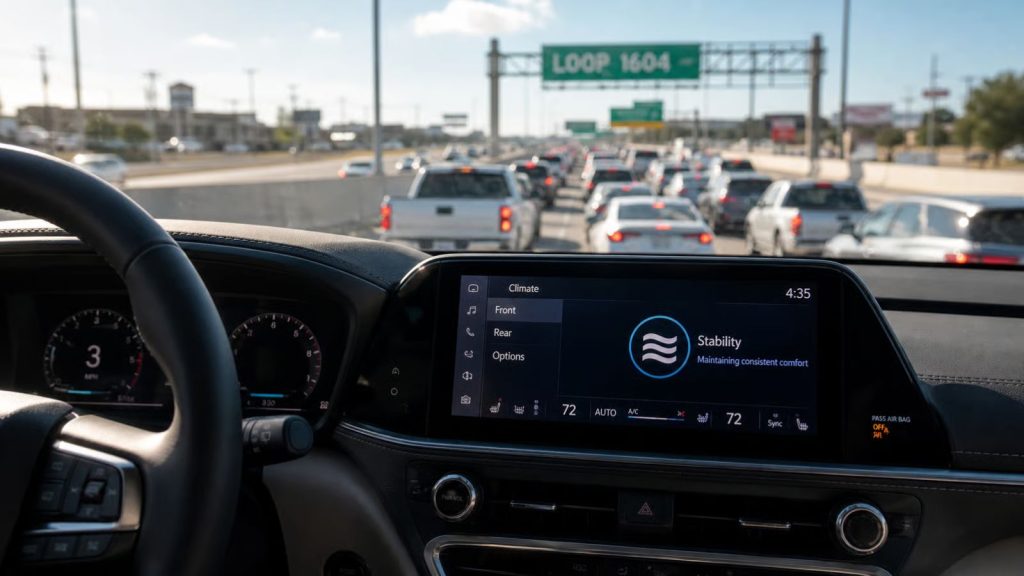
Stop and go conditions on a road like Loop 1604 create a specific kind of challenge. Engine load bounces between idle and acceleration in short bursts, and condenser airflow changes right along with it, sometimes getting a boost from moving air, sometimes losing it entirely during a stopped stretch. A fixed response system reacts to cabin temperature after the fact, adjusting only once things have already drifted from where they should be.
An adaptive system works differently. It pulls in real time data, cabin temperature, ambient temperature, engine load, sometimes vehicle speed, and uses all of it together to adjust compressor output and blend door position before cabin temperature has a chance to drift very far. Instead of reacting to a problem that’s already happening, it’s compensating for a condition that’s about to cause one, like reduced airflow the moment the vehicle comes to a stop.
How We Actually Diagnose These Systems
Diagnosing an adaptive system means looking at more than whether the compressor turns on. We check the logic behind when and how it adjusts.
We pull real time sensor input alongside compressor output commands through a scan tool built for this. A properly functioning adaptive system should show compressor output shifting within seconds of a meaningful engine load or airflow change, not lagging until cabin temperature has already moved several degrees off target.
We also run a simulated stop and go cycle and track cabin temperature stability throughout it. A system that’s adapting the way it should typically holds within 2 to 3 degrees of target even through frequent load swings. A system that’s not responding adaptively, whether from a fault or a component acting like an older fixed response system, can show variance of 6 to 8 degrees or more under those same conditions.
Sensor accuracy gets checked separately from all of this, because an adaptive system is only as good as the information feeding it. A cabin or ambient sensor reading off by 3 to 4 degrees from an independent reference measurement means the whole adaptive logic is working from bad data, even if every other component in the system is functioning perfectly fine.
Why We’d Rather Diagnose the Logic Than Just the Parts
As more vehicles come through with these adaptive systems, getting the diagnosis right means understanding what the system is actually trying to do, not just whether a compressor engages on command. Get it wrong in one direction and a real sensor accuracy issue undermining the whole adaptive response goes unnoticed. Get it wrong in the other direction and perfectly good components end up replaced unnecessarily, simply because the system was responding exactly the way it’s designed to under conditions someone didn’t fully understand.
Get Your Adaptive HVAC System Properly Diagnosed
If your vehicle uses an adaptive HVAC system and something feels off in stop and go traffic, we can check both sensor accuracy and system response rather than assuming it should behave like an older fixed response setup. Ruben’s AC repair specialists in San Antonio, 7210 Polar Bear, San Antonio, TX 78238, (210) 647-1148, work on these systems regularly.
Frequently Asked Questions
How do I know if my vehicle has an adaptive HVAC system?
Most newer vehicles with dual zone or advanced climate control use some form of adaptive logic. A shop familiar with your specific make and model can confirm through the system’s diagnostic parameters.
Is an adaptive system more likely to have problems than a traditional one?
Not inherently more likely, but diagnosing issues correctly requires checking sensor accuracy and system logic, not just whether the compressor engages, since a straightforward parts based check can miss what’s actually causing an issue.
Can a bad sensor cause my adaptive AC to behave unpredictably?
Yes. If a cabin or ambient temperature sensor is reading inaccurately, the adaptive system makes adjustments based on that bad data, which can look like inconsistent cooling even though the compressor and other components are working correctly.
Does Loop 1604 traffic specifically stress adaptive systems more than normal driving?
Stop and go conditions like Loop 1604 create more frequent load and airflow changes than steady driving, which gives an adaptive system more opportunities to demonstrate its response, for better or worse depending on system health.
Will a shop unfamiliar with adaptive systems misdiagnose the issue?
It’s possible. A shop checking only whether the compressor engages, without evaluating sensor accuracy or adaptive response timing, could either miss a real issue or replace parts that are actually functioning as designed.