
Brake calipers fail with age and mileage for a few common reasons, seized slide pins, a piston that no longer moves freely, torn dust boots that let in moisture, and worn internal seals. Any of these can make a caliper stick, drag, or leak. That is why we verify a caliper by checking how it actually moves, rather than condemning it from the symptom alone.
What a Brake Caliper Actually Does
The caliper translates hydraulic pedal pressure into physical stopping force. Pressing the brake forces internal pistons outward, squeezing the pads against the rotating brake rotor to create the friction that stops your vehicle.
Most vehicles use what is called a floating caliper. It does not just clamp, it also slides on a pair of guide pins so it can center itself and press both pads evenly. So the caliper really has two jobs, not one. It has to clamp when you brake, and it has to slide and let go cleanly when you release the pedal.
Keep that second job in mind, because it is the one that matters most when a caliper starts to fail.
The Release Side Is Where Trouble Starts
Here is the part most drivers never hear. When people picture a brake problem, they imagine the caliper failing to grab. In practice, the more common trouble is the opposite. The caliper grabs fine, but it does not fully let go.
A caliper that will not release cleanly keeps the pad in light contact with the rotor even after you lift off the brake. That constant contact is called drag, and it is the root of a whole chain of problems. The dragging pad wears itself down early, it heats up the rotor and the fluid, and it can pull the car slightly to that side. If a dragging caliper is the reason a car pulls or wears a pad unevenly, that ties back to how those symptoms show up, but the caliper itself is the part at fault here.
So when we look at a suspect caliper, the release side is where we look first. A caliper has to let go as cleanly as it clamps, and losing that ability is what most high-mileage failures come down to.
Seizing Versus Leaking, Two Different Failures
Caliper failures generally fall into two families, and they present differently.
The first is seizing, which is mechanical. The slide pins that let the caliper float can corrode and bind, so the caliper cannot center or release. Or the piston itself can stick in its bore from corrosion or debris, so it does not retract. Either way the caliper is physically stuck, and the result is drag, heat, and uneven wear. Nothing is leaking, the parts just are not moving the way they should.
The second is leaking, which is hydraulic. Inside the caliper are seals that hold brake fluid under pressure, and a rubber dust boot that keeps contamination out. When those seals wear or a boot tears, the caliper can weep brake fluid. You might see a wet spot on the caliper or the inside of the wheel, or notice the brake fluid reservoir dropping. A leaking caliper is a different problem than a seized one, and it points the diagnosis in a different direction.
Knowing which family you are dealing with, stuck or leaking, is the first fork in figuring out a caliper.
Why High Mileage Changes the Odds
A caliper on a low-mileage car and one on a high-mileage car are living very different lives, and that is why age matters so much here.
Every one of the failure modes above is cumulative. Corrosion builds slowly on slide pins and piston bores. Dust boots get brittle and crack over years of heat and weather. Seals harden with age and heat cycling. A newer caliper has not been through enough to develop these problems, while a high-mileage one has had years to accumulate them.
South Texas conditions push this along. Heat and humidity feed the corrosion that seizes slides and pistons, and they degrade the rubber boots that are supposed to keep moisture out. Add the constant heat-cycling of stop-and-go braking on Loop 410 or Loop 1604, and a dragging caliper that runs even hotter than normal, and you have the exact recipe that wears calipers out. That is why caliper failure shows up far more on older, higher-mileage vehicles than on newer ones.
How We Verify a Caliper Before Replacing It
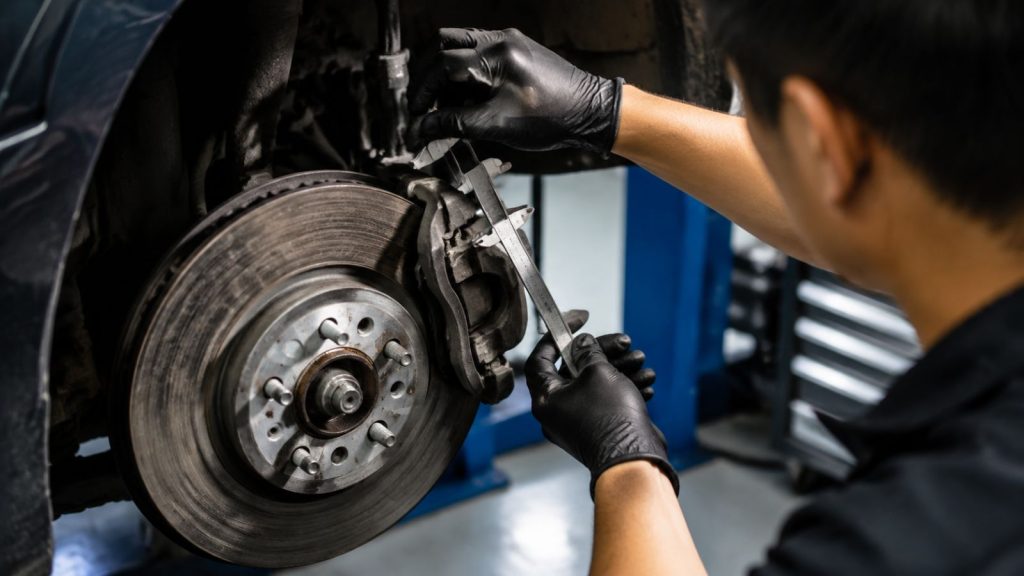
A caliper is not cheap to replace, so it is worth confirming that it is actually the problem before anyone swaps it. We verify a caliper by how it moves and what condition it is in, not by the symptom alone.
An inspection may include how the slides move and whether the piston retracts freely, since a caliper that will not release is the classic failure. The dust boots can be checked for tears that let in moisture and grit, and a dragging caliper often runs hotter than its partner, which can be checked. Looking at the caliper alongside the rest of the undercar services gives the full picture, because a bad caliper often shows up next to a scored rotor or a worn pad it is damaged. A thorough brake repair confirms the caliper is truly at fault first, so you are not paying to replace a part that was working.
Why a Sticking Caliper Is Worth Catching Early
A dragging caliper does not stay a small problem for long. Because it keeps the pad pressed against the rotor, it generates heat constantly, and that heat cascades. It cooks the pad, warps or scores the rotor, and can even overheat the brake fluid at that corner. A caliper caught early might just need service, while one left dragging for months often takes the pad and rotor down with it.
There is a safety side too. A caliper that sticks unevenly affects how the car stops and can pull it to one side under braking, which is not what you want in traffic. And a badly overheated brake can fade when you need it most.
If you have noticed a burning smell after driving, a wheel that runs hot, or the car tugging when you brake, those are worth checking before the damage spreads. Catching a caliper while it still just needs attention is far easier on the car and the budget than replacing everything it took with it.
Think You Might Have a Failing Brake Caliper
If your vehicle has miles on it and you have noticed dragging, a hot wheel, a pull, or a burning smell after driving, we can check whether a caliper is the cause. The goal is to verify how the caliper actually moves before recommending anything, so the fix matches the real problem. You can schedule an inspection or call the shop at (210) 647-1148 and we will take a look.
Frequently Asked Questions
What are the signs of a failing brake caliper?
Common signs include the car pulling to one side when braking, a wheel that feels hot after driving, a burning smell, uneven pad wear, or brake fluid leaking near a wheel. Any of these is worth checking, since they can point to a caliper that is either sticking or leaking.
Can I drive with a sticking brake caliper?
It is not something to put off. A sticking caliper drags constantly, which builds heat and can damage the pad, rotor, and even the brake fluid at that corner. It can also affect how evenly the car stops. The safer move is to have it checked before the heat causes a larger, more expensive repair.
What is the difference between a seized and a leaking caliper?
A seized caliper is a mechanical problem, the slides or piston are stuck and the caliper will not move or release freely. A leaking caliper is a hydraulic problem, worn seals or a torn boot let brake fluid escape. They present differently and point the diagnosis in different directions, which is why confirming which one you have matters.
Does high mileage always mean the calipers are bad?
No. Plenty of high-mileage calipers are still fine. Mileage raises the odds of corrosion, boot wear, and seal aging, but it does not guarantee failure. That is exactly why a caliper is verified by how it actually moves and its condition, rather than assumed bad just because the odometer is high.