
Wheel-speed sensors tell the ABS module how fast each wheel is turning. The module uses that data to prevent lockup during hard or slippery stops. When a sensor fails or sends a bad signal, the system usually shuts ABS off for safety, so the car still brakes but without anti-lock protection. That is why we treat an ABS sensor fault as a safety issue, not just a warning light.
What a Wheel-Speed Sensor Actually Does
Every wheel has a speed sensor, and its job is simple to state but important to understand. It reports how fast that wheel is spinning, moment to moment, to the ABS module. Four wheels, four streams of data, all flowing to one computer.
The module watches those four numbers constantly. In normal driving it does nothing you notice. The action starts during a hard or slippery stop, when one wheel starts slowing down much faster than the others, which is the signature of a wheel about to lock up and skid.
When the module sees that, it rapidly pulses the brake pressure at that one wheel, easing and reapplying many times a second, to keep the wheel rolling instead of sliding. A rolling wheel can still steer and still grip. That is the entire point of anti-lock braking, and none of it works without accurate wheel-speed data coming in. The sensor is the foundation the whole system stands on.
What Happens to Braking When a Sensor Fails
Here is the part that surprises people, and it is worth getting right. When a wheel-speed sensor fails, your brakes do not stop working. The car still brakes normally through the regular hydraulic system.
What you lose is the anti-lock layer on top. When the module stops getting a plausible signal from a sensor, it usually disables ABS entirely and turns on the ABS warning light. It does this on purpose, because a system that cannot trust its own data should not be pulsing your brakes. So the car reverts to conventional braking, the way vehicles stopped before ABS existed.
That means everyday driving feels the same, which is exactly why the problem gets ignored. You do not feel the loss on a normal stop in a parking lot. You feel it the day you brake hard on wet pavement and a wheel locks up when the anti-lock system would have kept it turning. The risk is not that you cannot brake. The risk is that you have lost the protection meant for the worst stop you will make all year.
The Systems That Fail Along With It
Wheel-speed data does not only serve the brakes. On most modern vehicles, that same signal is shared with other systems, which is why one small sensor can cause symptoms that seem unrelated.
Stability control and traction control both rely on knowing how fast each wheel is turning. When a wheel-speed sensor drops out, those systems often disable themselves too, sometimes lighting up their own dashboard warnings. On some vehicles the speedometer or certain transmission behaviors can be affected as well, because they read the same data.
So a single failed sensor can present as a cluster of warnings, and that can look alarming. Understanding that they often trace back to one shared input helps make sense of what would otherwise seem like several problems at once.
Why the Sensor Is Not Always the Failed Part
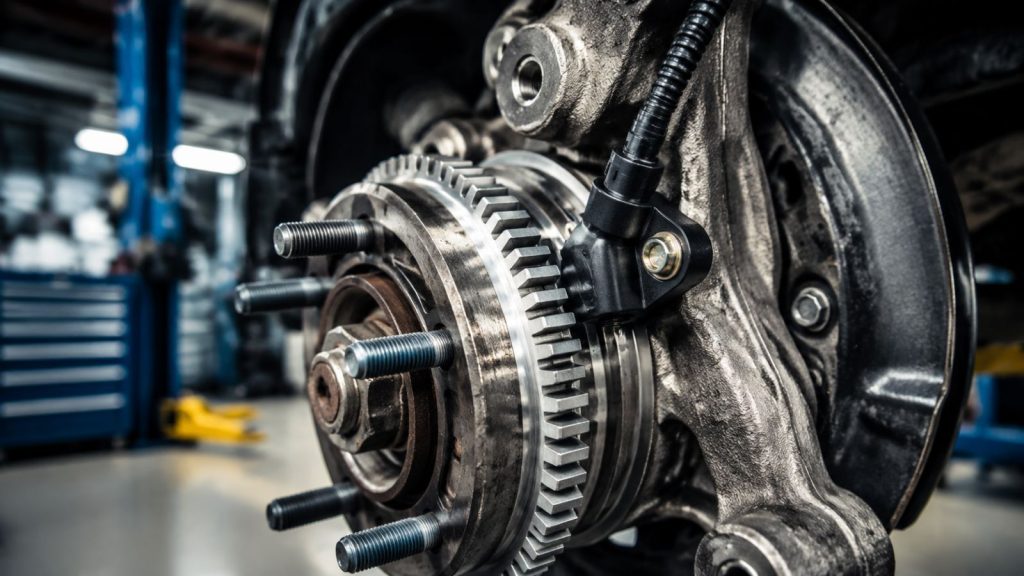
When a wheel-speed code appears, the sensor is the obvious suspect. But the sensor is only one link in a chain, and the fault can live anywhere along it.
The sensor reads a toothed ring, often called a tone ring or reluctor, that spins with the wheel. If that ring is cracked, packed with debris, or rusted, the sensor reads a bad signal even though the sensor itself is fine. The small air gap between the sensor and the ring matters too, and so does the wiring and connector running back from the wheel. Around San Antonio, those low-mounted parts take a beating from moisture, road grime, and the occasional pothole, and corrosion at a connector is a common culprit.
A sensor code points us to a wheel, but we still confirm whether it is the sensor, the tone ring, or the wiring. Replacing the sensor when the real problem is a damaged tone ring just leaves the light on and the money spent.
How a Sensor Fault Gets Confirmed
Confirming the actual cause takes more than reading the code. It takes checking whether the sensor is really doing its job.
Live wheel-speed data can show whether each sensor is reporting a plausible signal, and watching all four wheels together often reveals the one that drops out or reads erratically. That electronic side is where computer diagnostics earns its keep. But the data only tells half the story. An inspection may include the tone ring, connector, and wiring, not just the sensor, because live data can show a lost signal without telling you the ring is cracked or the connector is green with corrosion. We want the live data and the physical evidence to agree before we replace anything. That is how an ABS brake repair fixes the fault instead of the symptom.
Why This Matters Most When You Least Expect It
An ABS sensor fault is easy to shrug off precisely because the car feels normal. That is the trap. The system you have lost is a system that only shows up when you need it, and you do not get to choose when that is.
Think about a hard stop on a wet stretch of highway during a San Antonio downpour, or braking suddenly for traffic on slick pavement. Those are the moments anti-lock keeps your wheels from locking so you can still steer around trouble. With ABS offline, that same stop can end in a skid. Nothing about your daily commute warns you it is gone.
That is why we do not treat an ABS light as a someday problem. The brakes work today, but the safety margin is missing, and it is missing on exactly the day you would want it most.
Concerned About an ABS Sensor Problem
If your ABS light is on, or your stability or traction warnings have appeared, we can check the live sensor data and inspect the whole signal path to find the real cause. The goal is to confirm whether it is the sensor, the tone ring, or the wiring before replacing anything, so the anti-lock protection is actually restored. You can reach San Antonio auto repair at Ruben’s Auto Repair by calling (210) 647-1148 and we will walk you through it. Contact us today or check out our current special offers to learn more about our shop.
Frequently Asked Questions
Can I still brake with a bad ABS sensor?
Yes. Your regular brakes still work through the normal hydraulic system. What you lose is the anti-lock function, which prevents wheel lockup during hard or slippery stops. So the car stops as usual day to day, but the safety layer for panic and wet-weather braking is offline until the fault is fixed.
Can one ABS sensor affect the speedometer or traction control?
It can. Wheel-speed data is often shared with stability control, traction control, and on some vehicles the speedometer. A single failed sensor can disable those systems or trigger their warnings too, which is why one small part can seem to cause several unrelated problems at once.
Is it always the sensor when I get an ABS code?
No. The code points to a wheel, but the fault can be the sensor, a damaged or debris-packed tone ring, a bad air gap, or corroded wiring and connectors. Confirming which one it is takes live data plus a physical inspection, so the right part gets replaced instead of guessing.
What does a failing ABS sensor feel like when driving?
Often it feels like nothing during normal driving, which is what makes it easy to miss. Usually the first sign is the ABS light on the dash. You may only notice the missing protection during a hard or slippery stop, when a wheel locks up in a situation where anti-lock would have kept it rolling.