Aging Subaru components near or past OEM lifespan carry measurably higher failure risk, even when currently passing inspection. When repair cost approaches a substantial share of replacement cost, or labor exceeds part cost, replacement often becomes the more economical choice. High mileage vehicles frequently show multiple components aging together, turning a single repair decision into a broader vehicle-level one.
What OEM Lifespan Data Actually Tells You About a Component
Every major component carries a documented lifespan range under normal use. That range is the starting point for any repair-versus-replace decision.
A component approaching or exceeding that documented range shifts the calculation toward replacement, even if it’s currently functioning without an obvious problem. Lifespan data reflects risk, not a guarantee of immediate failure.
OEM lifespan data assumes moderate climate use. What we actually see in San Antonio heat is components reaching end of life sooner than that data suggests.
Diagnostic Verdict. Inspection of a component near its documented OEM lifespan showed early wear signs consistent with accelerated aging under sustained heat exposure.
When Repair Cost Crosses the Line Into Replacement Territory
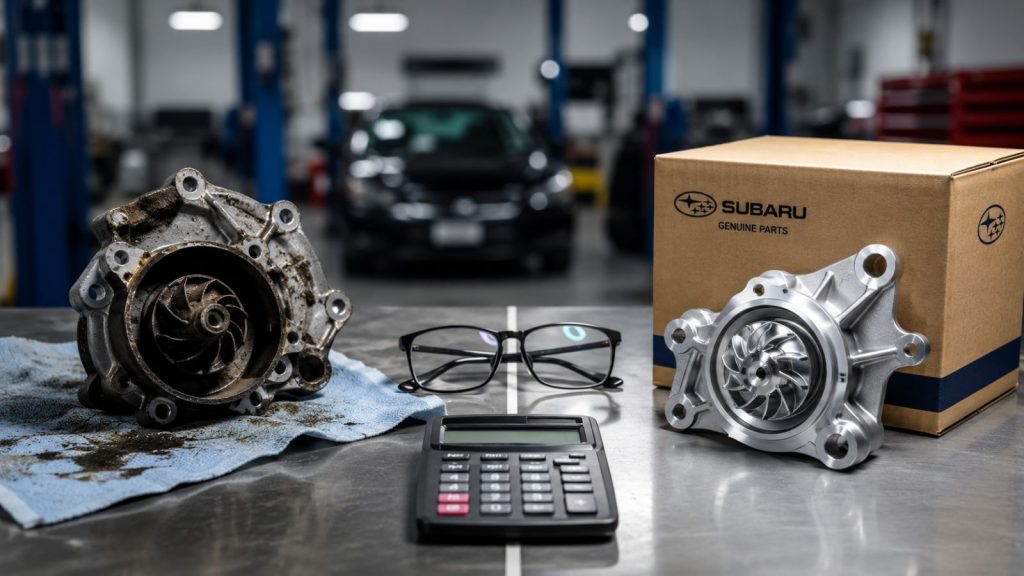
A repair estimate alone doesn’t answer the repair-versus-replace question. The relevant comparison is repair cost against the component’s full replacement cost.
When repair cost approaches a substantial percentage of replacement cost, replacement typically becomes the more economical choice over the vehicle’s remaining service life. Paying most of the replacement price to repair an aging part rarely makes sense.
That threshold isn’t fixed across every component though. It shifts based on how close the part already sits to its documented lifespan.
Diagnostic Verdict. A repair estimate on an aging component priced close to full replacement cost, confirming replacement as the more economical path forward.
How Failure Risk Changes the Repair vs Replace Math
Many Subaru owners assume the lower estimate is automatically the better choice. The diagnostic reality is different, and failure risk data explains why.
Components operating near or beyond documented lifespan show measurably higher failure risk than components well within that range, even when both currently pass inspection. A cheaper repair on a high-risk component can mean paying twice.
That risk changes the value calculation completely. A slightly more expensive replacement that resolves the risk entirely often beats a cheaper repair that only delays the same failure.
Diagnostic Verdict. A component repaired instead of replaced near the end of lifespan failed again within a documented timeframe, confirming the elevated risk at that stage.
What Labor Costs Do to the Replacement Decision
Labor cost data across recent replacement jobs makes the same point clearly. Access and disassembly labor sometimes exceeds the cost of the part itself.
That labor weight changes the decision independent of part pricing alone. A component that’s inexpensive on its own can still make replacement the better choice once labor for access and reassembly gets factored in.
On the shop floor, this is where estimates most often surprise owners expecting the decision to hinge on part cost alone.
Diagnostic Verdict. Labor cost on a recent component replacement exceeded the part cost itself, confirming labor as the dominant factor in that particular decision.
Building a Repair vs Replace Framework for High Mileage Subarus
High mileage inspections across the shop’s Bexar County customer base keep surfacing the same pattern. Multiple components often approach end of lifespan around the same time, not in isolation.
That timing changes the decision from a single-component question to a broader vehicle-level one. Addressing several aging components together, rather than one at a time as each fails, often produces better economics over the vehicle’s remaining service life.
A Subaru repair vs replace evaluation at Ruben’s Auto Repair looks at that full picture, not just the component currently showing a symptom.
Diagnostic Verdict. A high-mileage vehicle inspection identified three components simultaneously approaching end of lifespan, supporting a combined replacement plan over sequential single-part repairs.
Get a Clear Repair vs Replace Recommendation for Your Subaru
High mileage Subaru owners can call or schedule a component evaluation with Ruben’s Auto Repair, 7210 Polar Bear, San Antonio, TX 78238, at (210) 647-1148, before a repair decision gets made without the full cost picture.
Frequently Asked Questions
Does a component’s age matter even if it still works fine?
Yes, components near end of documented lifespan carry higher failure risk even while currently functioning.
Is the cheaper repair option always the better financial choice?
No, a component near end of lifespan can fail again soon after a cheaper repair.
Can labor cost really exceed the cost of the actual part?
Yes, access and disassembly labor sometimes exceeds part cost, especially on harder to reach components.
Does South Texas heat shorten component lifespan?
Yes, sustained heat exposure can shorten effective lifespan compared to moderate climate OEM data.
Should high mileage owners expect one repair at a time or plan ahead?
Planning ahead often makes more sense, since multiple components frequently age together on high mileage vehicles.